
Does your club have everything in place for returning to sport?
With outdoor sports about to return, and indoor sports facilities reopening on April 12th, according to the Government roadmap, now is the perfect time to ensure your club is as organised as possible.
But before you open your doors again, you may need to make some organisational changes – especially if you employ people. In this article, we explore how to identify the required changes, communicate them effectively to your staff, and ensure parents are well-informed at all times.
The first step in this process, though, is reminding yourself of your current organisational structure – how many people do you employ? And what are their responsibilities?
This is a particularly important task for clubs to undertake right now, because it highlights any necessary changes needed before you reopen. And having been in lockdown and away, physically, from your sports and clubs for a long time now, you’ve hopefully had the chance to reflect on and review your organisation.
Creating a formal organisational structure
No matter the size of your club, your organisational chart needs to clearly outline every employee’s position, and where they sit within your club’s hierarchy. The structure, which can be displayed in the form of a chart, starts with directors and board members at the top, followed by senior management, and then coaching staff and volunteers. There may be many levels in this chart, and also branches to different disciplines.
Here is an example organisational chart for a gymnastics club:
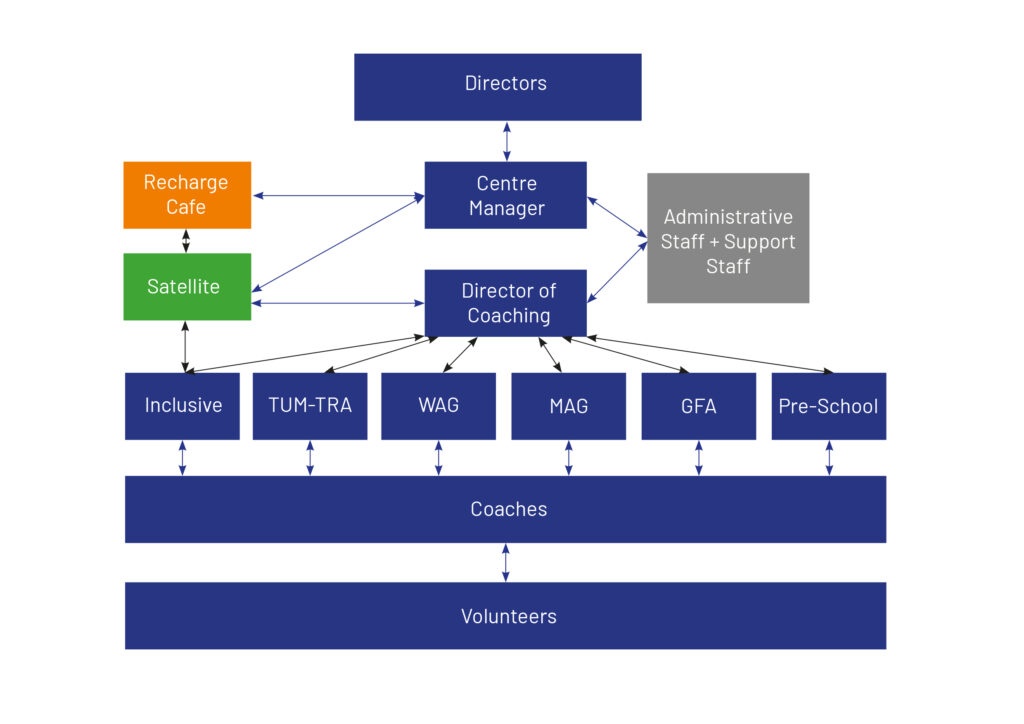
It’s important for all employees within your business to feature here; no matter their seniority, they are all vital pieces of the jigsaw that makes up your club.
Once you’ve built your organisational chart, it needs to be communicated to all employees. This helps people to understand where they fit within the wider business, and to get to grips with who is responsible for what. They can then be clear on who is the best point of contact for any of their enquiries. These are all things that may have altered or shifted slightly during the course of the pandemic, so it’s important you update everyone before your return.
Having a clear picture of all the areas and functions within your business also allows you to identify any skills or expertise gaps in your workforce. Note that gaps of this nature don’t always require increasing your headcount. It could simply be a case of improving your employee training programmes – something we’ve discussed previously in our article about Continuing Professional Development (CPD).
Which organisational changes are required at your club before the return to sport?
Now that you’re clear on the structure of your current workforce, and have outlined any gaps you may need to fill before returning, you need to think about the organisational changes that are required.
It’s a good idea to meet with your senior leadership team to discuss and decide these changes. When doing so, ensure you take into account factors such as the Government’s recent budget announcement. A couple of things that may impact your decision-making processes are:
- The furlough extension until September – do you need to make use of this?
- Increases to the National Minimum Wage and National Living Wage rates – from 1 April 2021, the National Living Wage will apply to employees aged 23 and over (the National Minimum Wage will applies to employees who are at least school leaving age). More information can be found on gov.uk
Although it may not be something you had previously considered, it could be worth increasing your membership fees. Even a very minor increase for each member provides a lot of help covering your staffing costs – particularly after a very challenging year for grassroots clubs. Remember, too, that you are likely to be picking up additional club costs with your return – for things like PPE and new, increased cleaning requirements.
Also, think about how you will go about bringing your employees back to work. If it’s feasible for everyone to return on the same hours and contracts as pre-COVID-19, then that’s great. But if not, think about potentially reducing some employee hours or changing contracts slightly, and make use of the furlough scheme while it’s available. You could consider reducing all employees’ hours slightly, if that then means you can bring the whole team back on-board.
Finally, you need to take into account any changes in employee responsibilities – for example, who will be in charge of the increase in cleaning? It’s essential that you are operating in a safe environment for all employees and athletes. Therefore that could mean taking on new staff members, or shifting responsibilities among your current workforce.
Communicating changes to employees
If there are going to be changes to your employees’ working hours or contracts, you need to ensure this is communicated to them clearly. And similar to our discussions in the Parent Factor series, there may be some difficult conversations to have with your people here.
But no matter how challenging or awkward this may seem, you must provide your team with plenty of notice. Also for those staff members you’re planning to keep on furlough for a little while longer, you need to give them a clear plan for when they will be coming back to work.
Being placed on leave from work – whether paid or not – can be very difficult, and challenging for people’s mental health. So bear in mind that many of your employees will be looking forward to their return to work. You therefore need to manage their expectations so as not to disappoint or upset them.
It’s worth noting here that if you would like to make any large-scale organisational changes, such as major changes to contracts, you should seek professional help and advice.
Communicating your plans to parents
Once you’ve had conversations with your employees and your organisation is prepared for reopening, the next step is to inform the parents.
It’s been a long time coming, so while you may have been in contact with parents throughout lockdown and running virtual training, now is the time to communicate a clear plan.
We have potential return dates from the Government, but these timeframes could change at any point and become delayed. So the best thing to do is set out your return plans in an email that is ready to be sent once you receive the green light.
You can do this using your LoveAdmin software to set up an email template that is ready to be sent whenever. If you navigate to the Knowledge Centre, you’ll find a help sheet to walk you through this process if it’s new to you.
–
Being able to reopen your club doors again is a very exciting prospect. And it’s important that you are as organised as possible, so that your return is successful. So ensure you have set out your organisational structure, identify any changes that need to take place, and communicate these changes to all relevant stakeholders.
If you’re involved with a gymnastics or football club and would like to see more content like this, join our dedicated Facebook Communities:


